
 Resources & Catalogs
Sourcing furniture involves navigating a complex supply chain where the distance between the buyer and the factory floor dictates both the final unit cost and the logistical burden. Buyers ranging from independent retailers and hospitality procurement officers to high-end interior designers must balance unit costs against Minimum Order Quantities (MOQs), lead times, and quality assurance risks. Choosing the right channel to procure a bedroom set requires aligning your purchasing volume, timeline, and operational capacity with the realities of retail, wholesale, and factory-direct models. This guide breaks down the technical evaluation criteria for each sourcing tier, providing a clear framework for optimizing your procurement strategy based on actual project demands and supply chain capabilities.
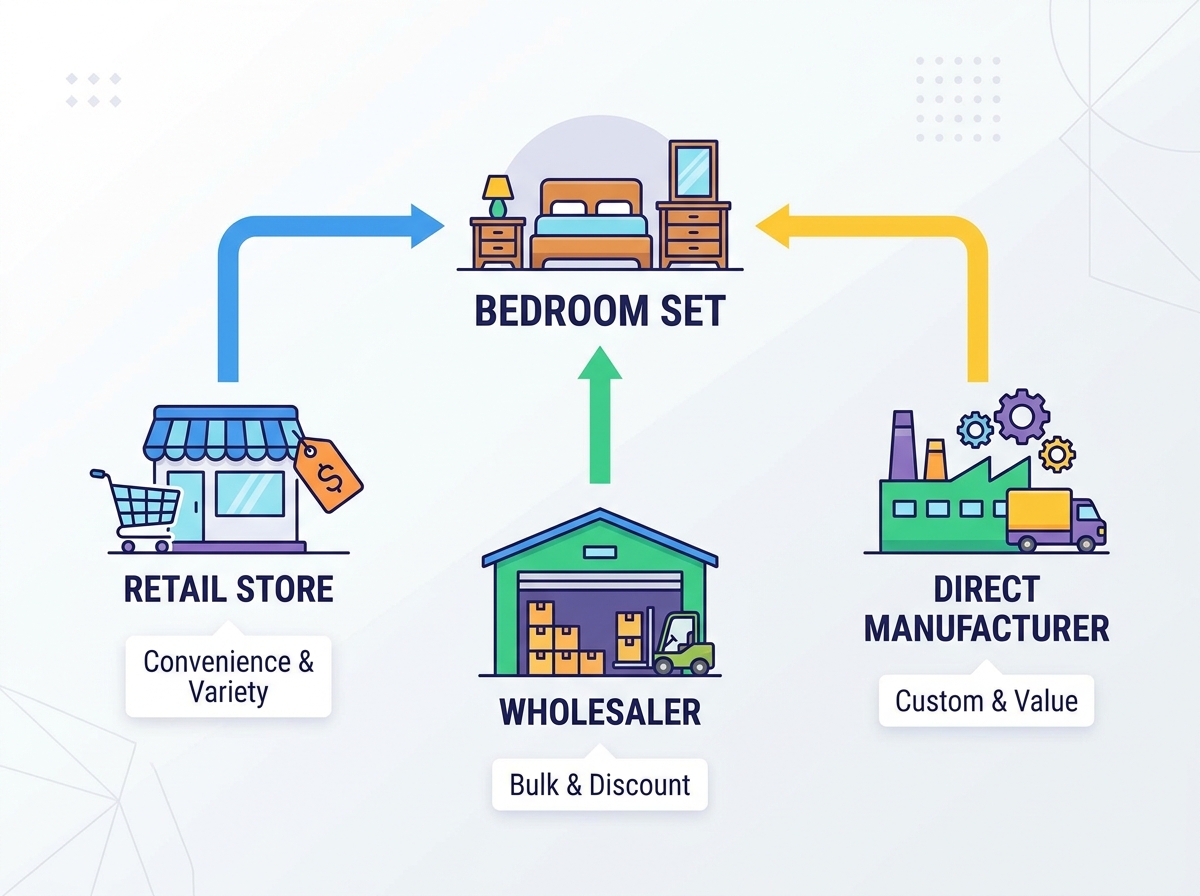
Retail/Trade Programs: Offer immediate availability and minimal logistical friction, but carry the highest unit costs and lack scalability for high-volume projects.
Wholesale Distributors: Serve as the optimal middle ground, providing domestic warehousing, curated catalogs, and commercial pricing without the extreme MOQs of factory-direct sourcing.
Direct Manufacturers: Deliver the lowest per-unit cost and full customization (OEM/ODM) but require sophisticated supply chain management, high capital outlay, and long lead times.
Establishing baseline metrics dictates which sourcing channel is viable for your specific project or retail operation. Procurement success relies on matching your operational capabilities with supplier requirements. You must evaluate your storage capacity, capital flow, and project timeline before engaging any vendor.
Define the scale of the purchase immediately. Single-unit needs versus container-load requirements instantly eliminate certain channels. Retailers accommodate single orders, while wholesalers require pallet or truckload minimums. Direct manufacturers demand full container loads, making volume the primary filter for supplier selection. If your warehouse cannot receive a 40-foot high-cube container, factory-direct sourcing is not a viable option.
Standard set compositions heavily affect packaging dimensions and shipping volume. A typical 3-piece configuration includes a bed frame and two nightstands, while a 5-piece setup adds dressers, mirrors, and chests. Larger configurations consume more cubic meters in a shipping container, directly impacting freight efficiency and warehouse storage requirements. You must calculate the exact cubic meter (CBM) footprint of each configuration.
Configuration Type | Included Pieces | Average CBM per Set | Estimated Sets per 40HQ Container |
|---|---|---|---|
3-Piece Standard | Bed Frame, 2 Nightstands | 0.8 - 1.2 CBM | 55 - 80 Sets |
4-Piece Suite | Bed Frame, 2 Nightstands, Dresser | 1.5 - 1.8 CBM | 35 - 45 Sets |
5-Piece Master | Bed Frame, 2 Nightstands, Dresser, Mirror, Chest | 2.0 - 2.5 CBM | 25 - 33 Sets |
Evaluating size availability across standard configurations (Twin, Full, Queen, King, and California King) is mandatory. Size variance impacts container volume optimization. Regional markets demand specific dimensions, and failing to match local mattress standards renders imported frames unusable. European King dimensions differ significantly from North American King dimensions, requiring precise specification sheets during the ordering phase.
Contrast immediate local availability against 60-to-90-day overseas production and shipping cycles. Projects with strict opening dates cannot risk ocean freight delays. Inventory stocking programs require predictable lead times to prevent stockouts during peak retail seasons. Buffer times must be built into every procurement schedule to account for port congestion or customs holds.
Evaluate the need for proprietary designs versus accepting standardized inventory. Custom finishes, specific hardware, and white-labeling require factory-direct relationships. Ready-to-ship inventory from wholesalers sacrifices uniqueness for speed and convenience. Commercial hospitality projects often require custom laminates and heavy-duty drawer glides that off-the-shelf retail products simply do not feature.
Utilizing big-box retailers, specialized online furniture platforms, or boutique showrooms offers unmatched convenience. Many professionals leverage designer trade discounts to improve margins slightly while maintaining speed. This channel eliminates the need for complex logistics management.
Understanding the different retail tiers helps narrow down the best source for immediate needs. Each sub-tier offers different advantages regarding inspection, delivery, and catalog size.
E-commerce Giants: Platforms prioritizing rapid shipping and vast consumer catalogs. They offer endless variety but limited quality control.
Traditional Brick-and-Mortar Chains: Brands offering physical inspection and predictable, flat-pack logistics. Buyers can verify material quality before purchase.
Warehouse Clubs and Bulk Retail: Warehouse programs offering bundled value with integrated LTL (Less-Than-Truckload) delivery networks.
Retail channels provide zero MOQs, white-glove delivery options, immediate stock availability, and localized customer service. Damaged goods are easily returned or exchanged locally. The logistical burden remains entirely on the seller, freeing the buyer from managing freight forwarders or customs brokers.
Retail markups severely limit profitability for resellers. This channel fails for multi-unit hospitality projects or inventory stocking due to high unit costs and inconsistent stock levels for large quantities. Scalability is practically nonexistent when relying on consumer-facing storefronts.
Interior designers staging single properties, boutique short-term rental operators, and consumers prioritizing speed and convenience over margin benefit most from this channel. It serves as a reliable fallback when project timelines compress unexpectedly.
Purchasing through commercial suppliers who buy in bulk from manufacturers and warehouse inventory domestically represents a highly efficient procurement strategy. Regional distributors and national wholesale brands bridge the gap between factory production and retail floors, offering a balanced approach to inventory management.
Wholesalers absorb import risks and freight logistics. They offer retailers and project managers access to diverse, curated catalogs at discounted rates. Buyers avoid the complexities of customs clearance and ocean freight while securing better margins than retail. This allows businesses to focus on sales and marketing rather than supply chain troubleshooting.
Selecting the right wholesale partner requires analyzing their operational infrastructure and catalog depth. A reliable wholesaler acts as an extension of your own warehousing capabilities.
Catalog Depth and Stylistic Curations: Assessing the variety of styles available from a single vendor allows buyers to consolidate purchasing. A strong wholesaler offers everything from contemporary modern designs to traditional casegoods.
Tiered Commercial Terms: Volume discounts are structured based on annual spend or order size, rewarding loyal buyers with improved margins over time.
Ordering Infrastructure: Navigating online dealer portals, real-time stock-level tracking, and automated regional inventory updates ensures accurate procurement planning.
Drop-shipping Capabilities: Evaluating wholesalers that offer direct-to-consumer fulfillment allows e-commerce retailers to scale without holding physical inventory.
The primary risk is stockouts on popular items. Mitigate this by integrating inventory management systems directly with the wholesaler to monitor real-time availability. Establish backup suppliers for core collections to ensure continuity of supply during peak demand periods.
Contracting directly with domestic or overseas factories to produce furniture at the source offers the highest potential reward but requires significant operational maturity. This channel demands rigorous quality control and substantial capital reserves.
Factory-direct sourcing delivers the lowest unit cost. Buyers dictate materials, dimensions, and hardware through OEM/ODM agreements. This control allows brands to build proprietary collections that competitors cannot easily replicate. You control the exact specifications, from the thickness of the veneers to the weight capacity of the bed slats.
Custom-manufacturing casegoods to specific architectural plans is essential for large-scale developments and commercial spaces. Factories engineer pieces to withstand commercial wear and tear, utilizing heavy-duty hardware and durable laminates. Hospitality environments require specific modifications, such as integrated power outlets and tamper-proof hardware.
Managing a factory-direct supply chain involves multiple moving parts and strict adherence to international trade regulations.
Freight and Customs: Navigating ocean freight, freight forwarders, import duties, and port fees requires dedicated logistics personnel.
Compliance: Ensuring materials meet regional regulations is mandatory. Composite woods must pass formaldehyde emission standards, and upholstery must meet regional flammability requirements.
Drayage and Unloading: Coordinating the transport of the container from the port to your warehouse and ensuring you have the labor and equipment to unload it within the allotted free time.
Quality control is the most significant vulnerability when buying direct. Once a container ships, returning defective items is virtually impossible.
Quality Assurance: Third-party pre-shipment inspections are necessary to prevent receiving a container of defective goods. Inspectors must check moisture content, finish consistency, and structural integrity.
Payment Terms: Managing cash flow through standard factory terms requires capital reserves. Standard agreements involve a deposit before production and the balance paid against the Bill of Lading.
The optimal channel for buying a bedroom set depends entirely on your position on the volume-versus-convenience spectrum. Retail offers speed, wholesale provides balanced margins with domestic reliability, and direct manufacturing delivers maximum customization at container-volume scale. To move forward effectively, execute the following steps:
Audit your immediate volume needs and warehouse receiving capabilities.
Calculate your acceptable landed costs, factoring in freight and potential defect allowances.
Request line sheets and commercial account applications from three distinct wholesale distributors.
Verify compliance certificates (such as TSCA Title VI) before placing any factory-direct purchase orders.
A: Wholesale minimums vary by distributor. Some require a minimum dollar amount per order, while others mandate pallet-sized shipments or specific unit counts per SKU. Drop-ship programs may waive MOQs entirely for approved commercial accounts.
A: Generally, no. Direct manufacturers operate on container-load volumes and require commercial documentation. Consumers must purchase through retail channels or specialized trade programs.
A: Ocean freight, port fees, and domestic trucking add significant overhead. These logistical expenses must be amortized across the total units in the container to determine the true landed cost per item.
A: A manufacturer physically produces the goods in a factory. A wholesaler purchases finished goods in bulk from manufacturers, imports them, warehouses them domestically, and resells them in smaller quantities to retailers.
A: Production typically takes 30 to 60 days, followed by 30 to 45 days for ocean transit and customs clearance. Buyers should plan for a 60 to 120-day lead time from purchase order to warehouse delivery.
A: Look for TSCA Title VI or CARB Phase 2 compliance for composite wood products to ensure safe formaldehyde emission levels. Verify that any upholstered components meet local flammability standards.


