
 Resources & Catalogs
Squeezing your life into a tiny bedroom often feels like a frustrating game of Tetris. You desperately need the utility of a nightstand for everyday essentials. You need a spot for charging your phone overnight. You need a place to hold a glass of water. You also need space to keep a reading light nearby. However, you simply lack the floor clearance for standard furniture dimensions. It is time to shift your core decision-making goal. Instead of focusing on buying a traditional table, you must focus on solving the specific functional needs of your bedside area.
We will explore how to evaluate your space based on strict physical constraints. You will learn how to measure floor clearance accurately. We will also cover renter compliance regarding wall drilling and structural modifications. Finally, we will discuss required weight capacities for various storage solutions. This guide provides a clear framework to help you maximize bedside functionality without sacrificing precious square footage or violating your lease agreement.
Assessing specific functional needs (e.g., holding a glass of water vs. heavy books) dictates the viability of alternative solutions.
Wall-mounted and bed-attached organizers offer the highest utility when lateral floor space is zero.
Integrating multi-purpose bedroom furniture for compact rooms (like headboard storage or C-tables) eliminates the need for standalone nightstands.
Measurement accuracy—specifically mattress height and baseboard depth—is critical before selecting a space-saving bedside table alternative.
You cannot solve a spatial problem without knowing your exact parameters. Many people purchase compact furniture only to realize it still blocks a closet door. Before browsing for a traditional bedside table or an alternative, you must define your boundaries.
Precision is essential when measuring tight spaces. You must measure the exact clearance between the bed frame and the adjacent wall or closet door. Do not measure from drywall to drywall. Baseboards easily consume an inch of usable space.
Measure from the thickest part of your baseboard.
Measure the distance to the edge of your bed frame.
Account for any mattress overhang. A soft mattress often bulges an extra inch past the frame.
Check the swing radius of nearby doors or dresser drawers.
If you have less than 15 inches of width available, standard tables will not fit. You must pivot to alternative vertical solutions.
You must separate what you actually need from what you simply want. Clutter blindness often leads us to overestimate our surface area requirements. Categorize your bedside items strictly.
Essential items include your smartphone, prescription eyeglasses, and daily medication. These items require immediate, easy access. Non-essential items include thick novels, decorative lamps, and large water carafes. You can store non-essentials elsewhere or replace them with wall-mounted alternatives. Identifying these needs dictates the weight capacity your solution must support.
Table 1: Bedside Utility Audit Matrix
Item Category | Examples | Weight Class | Ideal Storage Solution |
|---|---|---|---|
Absolute Essentials | Phone, glasses, medication | Under 2 lbs | Picture ledges, mattress caddies |
Hydration & Lighting | Water glass, reading lamp | 2 - 5 lbs | Sturdy floating shelf, clamp-on tray |
Entertainment | Books, tablets, journals | 5 - 10 lbs | Rolling carts, storage headboards |
Your housing situation dictates your installation methods. Renters often face strict clauses against modifying walls. Homeowners have more freedom but still face structural realities.
Assess whether wall drilling is permitted. If you rent, you might lose your security deposit for large holes. You must also identify your wall type. Drywall requires specialized anchors for heavy loads. Masonry or brick walls require masonry bits and heavy-duty concrete screws. Knowing your wall type helps you gauge true weight-bearing realities before buying hardware.
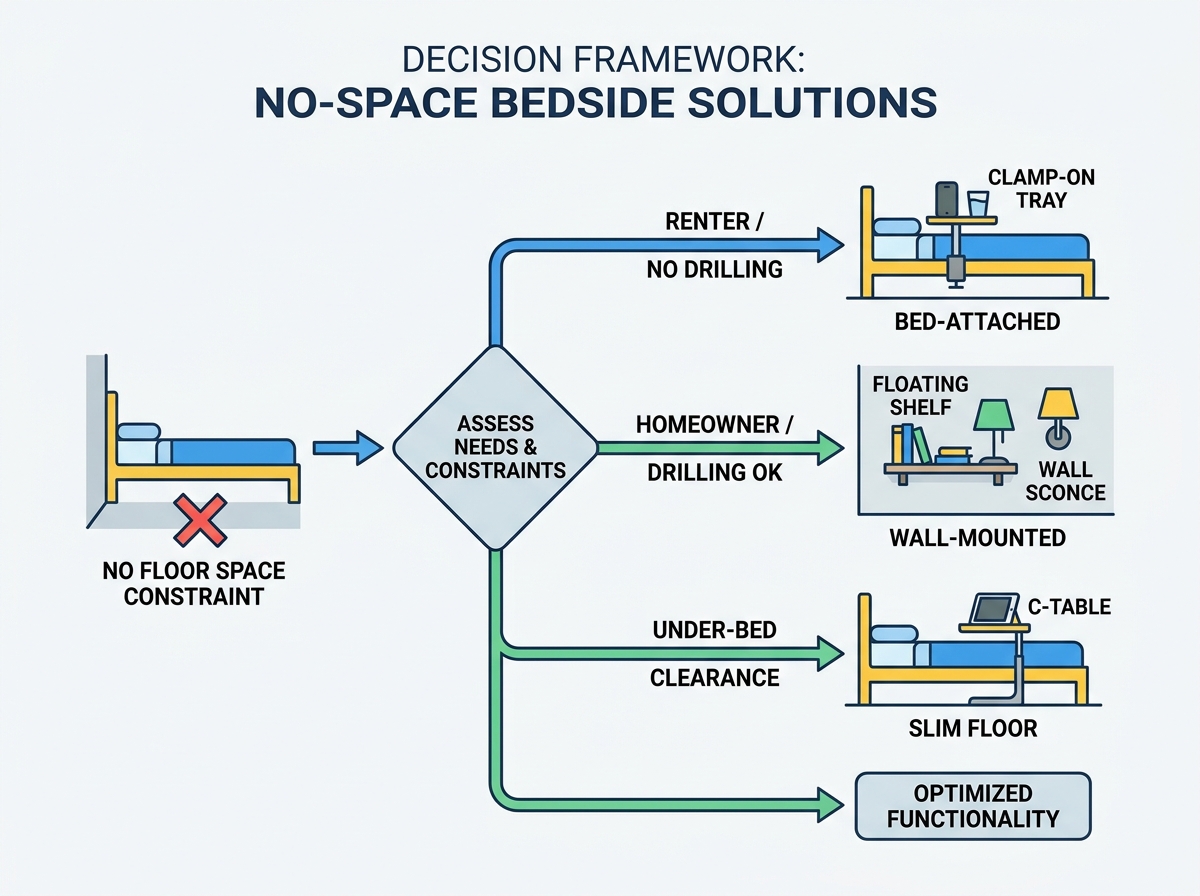
When lateral floor space equals zero, you must look up. Utilizing vertical wall space is the most effective way to gain surface area. Wall-mounted hardware eliminates your floor footprint completely.
Floating shelves provide a sturdy, permanent surface beside your bed. They represent a highly customizable approach to bedroom design.
Pros: This solution completely eliminates any floor footprint. You can mount them at the exact ergonomic height you prefer. Cleaning the floor underneath becomes incredibly easy.
Implementation Risks: Standard drywall cannot support a heavy floating shelf safely. You must locate wooden wall studs for secure installation. If studs are unavailable, you must use heavy-duty toggle bolt drywall anchors.
Picture ledges offer a shallower alternative to deep floating shelves. They typically measure only two to four inches deep. They are too narrow for standard table lamps. However, they are absolutely ideal for propping up smartphones and holding reading glasses safely.
Best Practice: Always install shelves with a slight raised lip if you plan to keep water glasses nearby. This prevents catastrophic spills onto your mattress.
Lighting takes up significant real estate on any flat surface. A standard lamp base easily consumes a seven-inch radius.
Outcome: Installing a wall-mounted sconce removes the need for a flat surface to hold a bedside lamp. This frees up your shelf exclusively for essential items.
Consideration: Hardwiring a new light fixture involves electricians and expensive permits. You should opt for plug-in sconces instead. These fixtures mount to the wall but plug directly into a standard electrical outlet. They bypass hardwiring costs and avoid electrical compliance issues for renters. You can manage the dangling cords neatly with adhesive cable clips.
Renters who cannot drill holes need non-destructive solutions. Bed-attached organizers leverage your existing furniture to create instant storage. They require zero tools for installation.
Clamp-on bedside trays act as temporary miniature tables. They are highly popular for dorm rooms and rented apartments.
Mechanism: This device attaches directly to the bed frame rail using a heavy-duty tension clamp. You simply tighten the threaded knob until the tray grips the wood securely. Most models feature felt or rubber pads to prevent scratching your bed frame.
Limitations: These trays are not universally compatible with all bed frames. They fail on platform beds featuring thick upholstered rails. They also struggle on rounded metal pipe frames. Furthermore, they enforce strict weight limits. Most manufacturers cap their capacity at 10 to 15 lbs. Resting your body weight on the tray will break the clamp.
Fabric pocket organizers provide stealthy, low-profile storage. They drape silently down the side of your bed.
Mechanism: The organizer features a long, flat fabric flap. You slide this flap directly under the mattress. It utilizes the heavy weight of the mattress for structural stability. Gravity holds the caddy securely in place.
Best Use Case: A caddy excels at holding flat or lightweight items. It perfectly houses tablets, television remotes, magazines, and e-readers. It keeps cables tidy and out of sight.
Common Mistake: Never use a fabric mattress caddy for open liquids. They lack structural rigidity. Placing a water glass inside a pocket guarantees a messy spill. Limit their use to dry goods and electronics only.
Sometimes you still desire floor-based furniture. When width is severely constrained, you must reconsider furniture shapes. Multi-functional pieces can navigate tight clearances intelligently.
C-tables were originally designed to slide over living room sofas. They adapt brilliantly to tight bedroom environments.
Advantage: The unique cantilevered base slides directly under the bed frame. This action brings the table surface hovering directly over the mattress. You gain a functional surface without requiring lateral floor space beside the bed.
Measurement Check: You must verify the clearance underneath your bed. A C-table requires at least two to three inches of vertical clearance under the bed to accommodate its metal base legs. If your bed frame sits flush against the floor, this solution will fail.
Utility carts offer dynamic, movable storage. They adapt to your daily routines effortlessly.
Advantage: A slim rolling cart is highly mobile. You can pull it out at night to serve as a space-saving bedside table. During the day, you can roll it away into a closet or an unused corner. This maintains clear walking paths in tiny rooms.
Evaluation: A slim cart acts as highly efficient bedroom furniture for compact rooms. You gain multiple tiers of vertical storage. However, they can feel quite unstable if placed on thick, plush carpets. Ensure you purchase a cart with large, smooth-rolling casters if your bedroom is carpeted.
You can often find solutions hidden within your room's existing layout. Repurposing architectural elements saves money and reduces clutter. It requires you to look at your space creatively.
Many older homes feature deep, substantial windowsills. If your bed layout permits it, this area offers free surface space.
Viability: If the bed is positioned directly under or next to a window, a deep sill serves as a natural surface. You do not need to buy or install anything. It comfortably holds glasses, small books, and alarm clocks.
Risks: Windows are prone to temperature fluctuations and moisture. Condensation from cold windows can easily drip and damage expensive electronics. Furthermore, managing charging cables across a window frame requires careful cable management. Use adhesive cord clips to keep charging wires from looking messy.
When lateral space is non-existent, you must expand horizontally behind the bed. The headboard presents a massive opportunity for optimization.
Strategic Shift: A storage headboard replaces the need for a separate table entirely. It shifts all utility storage to the head of the bed. These units feature built-in cubbies, hidden shelves, and integrated charging ports.
ROI: This strategy carries a higher initial cost than buying a cheap shelf. You must replace a major piece of furniture. However, it maximizes vertical space brilliantly. It provides ample storage without widening the bed's overall floor footprint. It represents a permanent, elegant solution for cramped quarters.
Lacking floor space does not mean you must sacrifice bedside functionality. You simply have to rethink how you hold your essential items. Traditional tables are not mandatory for a comfortable nighttime routine.
The best choice ultimately depends on a careful cross-reference of your constraints. You must balance your needed surface area against your installation permissions. You must also rely on exact, precise measurements rather than visual guesses.
Measure your specific bed-to-wall clearance down to the quarter-inch.
Account for baseboards, mattress overhang, and carpet thickness.
Identify your top three absolute bedside essentials to determine weight capacity needs.
Select a renter-friendly or permanent solution based on your housing rules.
Complete these action steps before purchasing any hardware or alternative furniture. By planning carefully, you will create a highly functional, clutter-free sleeping environment.
A: Typical nightstands require 18–24 inches of clearance. Anything under 15 inches requires a specialized space-saving bedside table or an alternative vertical solution. If your space measures less than 12 inches, you should abandon floor-based furniture entirely and focus on wall-mounted or bed-attached options.
A: Prioritize hard-mounted floating shelves or clamp-on trays with raised lips to prevent spills. The raised edge acts as a physical barrier against accidental bumps in the dark. You must absolutely avoid fabric mattress caddies for liquids, as they lack the rigid support required for open cups.
A: You can only do this if utilizing a lightweight, mobile solution. A slim rolling cart works well here. You can move it easily daily to maintain clear egress paths. This ensures you maintain compliance with standard residential fire safety norms while keeping your closet fully accessible.
A: Generally, you should align the shelf with the top of your mattress or up to 4 inches higher. This specific height ensures ergonomic reach while you are lying down. It also prevents you from accidentally hitting your head on the shelf edge while sleeping or sitting up.


