
 Resources & Catalogs
Furnishing a primary suite requires a substantial financial investment, leaving many homeowners facing a distinct design dilemma. Purchasing a pre-bundled suite risks creating a dated, sterile showroom look that lacks personality. Conversely, buying individual pieces without a clear strategy risks a chaotic, disjointed space that fails to promote rest and relaxation. Creating a coordinated modern bedroom requires understanding how to balance cohesion with character. This guide introduces a practical framework for evaluating whether to purchase a complete matching suite or curate individual pieces. We explore aesthetic longevity, spatial constraints, and procurement efficiency to help you build a restful, highly functional space.
The Verdict on Matching: Identical, heavily ornamented matching suites are largely considered dated, but coordinated, streamlined sets remain highly relevant for modern, minimalist spaces.
The Curated Alternative: Mixing furniture requires a strict underlying framework (unifying wood undertones, hardware, or design eras) to maintain visual calm.
Cost vs. Time Trade-off: Bundled bedroom sets offer procurement efficiency and cost savings; curated spaces require more time and often a higher aggregate budget but yield a highly personalized result.
The Anchor Principle: Regardless of the approach, the bed frame (especially low-profile, contemporary designs) should dictate the scale and style of the surrounding case goods (dressers, nightstands).
The standard components of a traditional matching suite typically include a bed frame, two identical nightstands, a wide double dresser, and often a tallboy chest or an attached mirror. Historically, this approach dominated the furniture market due to its guaranteed cohesion. Buyers appreciated the simplicity of single-source delivery and the elimination of decision fatigue. A matching suite ensured that wood finishes, hardware, and architectural details aligned perfectly across the room. Manufacturers built these suites using the exact same stain batches and veneer cuts, providing a safe, uniform aesthetic that left no room for error. The heavy ornamentation, matching corbels, and identical drawer pulls created a highly structured environment.
In decades past, purchasing a complete suite was a hallmark of establishing a household. The matching mirror bolted to the back of the dresser and the imposing headboard with a matching footboard dictated the entire layout of the room. While this guaranteed that nothing clashed, it also meant the furniture dominated the space, often ignoring the architectural nuances of the room itself.
Modern interior design favors the curated approach, which involves sourcing complementary rather than identical pieces. This method relies on blending different textures, materials, and eras to create depth. The psychological shift away from catalog rooms reflects a desire for spaces that feel collected over time rather than purchased all at once. An unfitted bedroom integrates layered textures and respects the room's architectural features, resulting in a highly personalized environment that feels intentional and lived-in.
Curating a room might involve pairing a contemporary upholstered platform bed with vintage mid-century modern nightstands and a sleek, modern metal dresser. This approach requires a sharper eye for proportion and scale. You must evaluate how the matte finish of a steel lamp interacts with the open grain of an oak nightstand. The unfitted bedroom thrives on these subtle contrasts, creating a dynamic visual landscape that a matching suite simply cannot replicate.
Highly specific matching designs, especially those with heavy ornamentation or trendy finishes, tend to age quickly. A room filled with identical pieces can feel anchored to the specific year it was purchased. In contrast, mixing vintage and contemporary pieces offers greater aesthetic longevity. The success criteria for a curated room depend on intentionality. The space must feel restful and cohesive, avoiding the chaotic appearance of randomly assembled furniture. A well-curated room adapts easily to updated decor, whereas a rigid matching suite often requires a complete overhaul to modernize.
Consider the lifespan of interior trends. A heavily distressed farmhouse suite purchased a decade ago now clearly broadcasts its age. However, a room anchored by a simple, high-quality solid wood bed frame can transition through multiple design movements simply by swapping out the nightstands or updating the textiles. Aesthetic longevity relies on flexibility, and curated spaces inherently possess more flexibility than locked-in suites.
Financial trade-offs play a major role in how you furnish a primary suite. Buying a bundled bedroom set often provides a bulk-discount reality, making it a highly efficient procurement method. Sourcing individual pieces from multiple vendors usually commands a premium. You must factor in cumulative shipping costs, varying delivery timelines, and multiple assembly requirements. While curating pieces allows you to spread out purchases over time, the aggregate budget generally exceeds the cost of a single, bundled purchase.
Logistics also heavily influence this decision. Freight shipping for large furniture is expensive and complicated. Receiving a single pallet containing an entire suite from one manufacturer is vastly simpler than coordinating four different less-than-truckload (LTL) freight deliveries from four different vendors. You must weigh the value of your time and the stress of managing multiple shipments against the desire for a highly customized look.
Approach | Procurement Speed | Aesthetic Longevity | Budget Efficiency | Logistical Complexity |
|---|---|---|---|---|
Matching Suite | Fast (Single Delivery) | Moderate (Can date quickly) | High (Bundled pricing) | Low (One shipment) |
Curated Mixing | Slow (Multiple Vendors) | High (Timeless appeal) | Low (Individual shipping/premiums) | High (Multiple tracking numbers) |
Pre-packaged suites often ignore the realities of modern, smaller, or uniquely shaped rooms. Bulky footboards and oversized dressers can overwhelm limited square footage. Individual sourcing allows you to maximize available space. For example, you can pair a low-profile bed frame with asymmetrical nightstands or utilize floating shelves in tight corners. Bed placement and layout archetypes dictate that furniture must adapt to architectural limitations. In square, rectangular, or complex master suites, forcing a massive matching suite into the layout disrupts the natural traffic flow and makes the room feel cramped.
When dealing with a 12x14 foot room, a standard five-piece suite will likely consume every available inch of wall space. This leaves no room for a reading chair, a floor mirror, or even adequate walking clearance. Curating pieces allows you to select a narrower dresser or opt for wall-mounted sconces instead of table lamps, freeing up surface area on smaller nightstands.
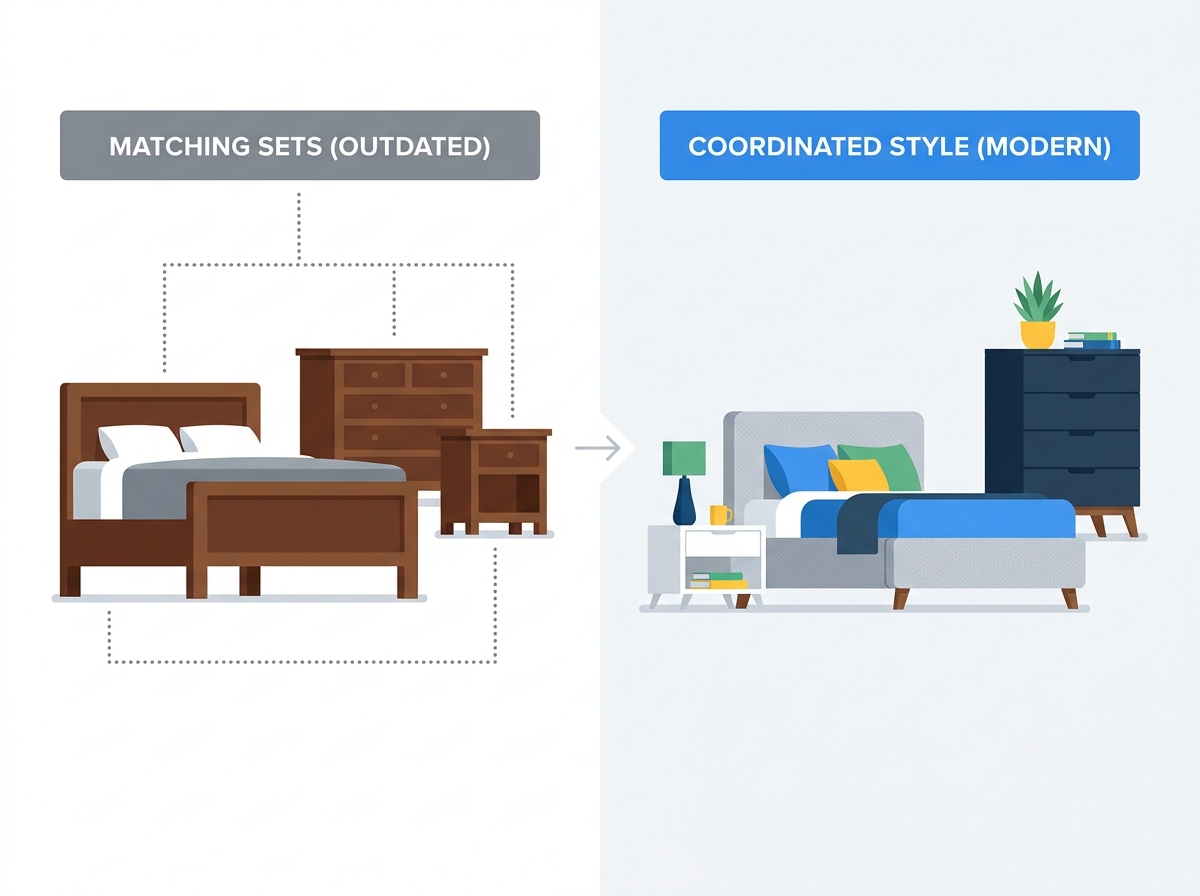
Mixing furniture successfully requires a strict underlying framework. Pieces must share at least one core trait to prevent the room from looking like a thrift store collection. This unifying element could be similar wood undertones, matching metal hardware, or a shared design era, such as Mid-Century Modern or Scandinavian minimalism. By establishing a common thread, you allow the eye to travel smoothly across the room, recognizing the intentional connections between distinct pieces.
Wood undertones are the most critical factor. You can mix different wood species—like oak and walnut—provided they share a similar warmth. Pairing a warm, orange-toned cherry dresser with a cool, gray-washed ash bed frame creates immediate visual friction. If the woods differ, ensure the hardware across all pieces matches. Unlacquered brass pulls on both a vintage dresser and modern nightstands can tie disparate styles together seamlessly.
Designers frequently utilize the 80/20 rule to maintain visual calm while introducing character. Approximately 80% of the room should follow a primary style or color palette, establishing a solid baseline. The remaining 20% acts as a contrasting accent. For instance, you might pair a modern upholstered bed and sleek nightstands (the 80%) with an antique wooden dresser (the 20%). Incorporating high-contrast color theory, such as pairing dark matte metal accents with light oak, prevents a mixed-material room from looking muddy or uncoordinated. Crisp lines and contrasting colors provide necessary definition.
This ratio prevents the room from feeling split down the middle. If you attempt a 50/50 split between two distinct styles, the room will feel confused and lack a clear point of view. The 20% accent piece should be a focal point, drawing the eye and adding personality without overwhelming the foundational calm established by the 80% majority.
Pairing unmatched pieces demands strict attention to scale and proportion. The low-profile rule dictates that lower-sitting bed frames create a modern, contemporary feel. Consequently, surrounding case goods must be scaled down in height to match this contemporary profile. A massive, tall dresser will dwarf a low-platform bed. As a general guideline, nightstand height should align roughly with the top of the mattress. The mass of the dresser must balance the visual weight of the bed frame, ensuring no single piece visually dominates the room.
Mattress thickness heavily influences this balance. A modern 14-inch mattress on a platform base will sit much higher than a standard 10-inch mattress. You must measure the final sleep surface height before purchasing nightstands. If your sleep surface is 24 inches off the floor, your nightstands should be between 22 and 26 inches tall. Anything outside this range will look disproportionate and make reaching for items uncomfortable.
Matching furniture still holds immense value in specific design contexts. Contemporary, low-fuss designs with crisp lines and integrated hardware often benefit from a unified, monolithic look. In modern minimalist spaces, the absence of visual clutter is paramount. A sleek, matching suite creates a seamless, uninterrupted flow that enhances the feeling of serenity and spaciousness.
These modern suites often feature handle-less drawers with push-to-open mechanisms and floating bed frames that hide the legs. Because the design language is so stripped back, matching the pieces does not create the heavy, oppressive feeling associated with traditional ornate suites. Instead, it creates a clean architectural baseline.
Buying complete suites offers excellent returns for low-traffic rooms. In guest rooms or secondary spaces, rapid procurement and baseline functionality outweigh the need for high-end, individualized curation. A bundled suite allows you to furnish these spaces quickly and cohesively, providing guests with a comfortable, put-together environment without demanding extensive design effort.
Guest rooms rarely require the same level of personalized expression as a primary suite. The goal is universal comfort and practical storage. A simple three-piece matching suite achieves this efficiently, freeing up your budget and mental energy for the main living areas of the house.
Matching suites provide immense utility during time-sensitive scenarios. For new home move-ins, cross-country relocations, or starting-from-scratch situations, decision fatigue runs high. Purchasing a complete suite solves the immediate need for functional storage and a place to sleep. It streamlines the logistics of moving, allowing you to focus on settling into the new property rather than coordinating multiple furniture deliveries.
When you have a strict 48-hour window to make a house livable, waiting six weeks for a custom-upholstered bed and another three weeks for vintage nightstands to ship is not viable. A matching suite delivered and assembled in one afternoon provides immediate stability.
The primary risk of a matching suite is that it looks sterile, impersonal, and lacks depth. To mitigate this, you must use soft furnishings and styling elements to disrupt the monotony. The designer’s styling toolkit includes high-value layering tactics. Install custom-length window treatments, hang oversized statement artwork, and utilize multi-textured, organic bedding. These elements break up the hard lines of a matching suite and inject necessary warmth and personality into the space.
Avoid buying the matching lamps or the matching bench that the manufacturer suggests. Introduce a vintage wool rug to ground the space, and use linen sheets to add a relaxed, organic texture that contrasts with the rigid lines of the furniture. Lighting is also critical; swap out standard builder-grade fixtures for a statement chandelier or architectural sconces.
When attempting to mix furniture, a common risk is accidentally pairing warm woods like cherry or mahogany with cool, ashy woods. This creates visual friction and makes the room feel unsettled. To mitigate this, stick to a strict warm/warm or cool/cool wood palette. If you already have clashing woods, use painted furniture in neutral tones like black, white, or olive green to act as a visual bridge between the conflicting finishes.
Understanding the color wheel is essential here. Red oak and walnut both have warm undertones and can sit comfortably next to each other. However, placing a yellow-toned pine dresser next to a gray-washed maple bed will look like a mistake. When in doubt, separate conflicting wood tones with a large area rug or a painted accent piece.
Forcing every piece of a standard suite into a room that only comfortably fits three will ruin the layout and natural flow. Overcrowding destroys the restful atmosphere a bedroom requires. Measure your floor space meticulously before purchasing. Prioritize the bed and nightstands as the essential components. If space is tight, consider moving the dresser to a walk-in closet or opting for tall, narrow storage solutions rather than wide, bulky units.
You must maintain a minimum of 36 inches of clearance around the sides and foot of the bed for comfortable navigation. If adding a dresser reduces this clearance to 24 inches, the room will feel cramped and frustrating to use. Always map out the furniture footprint on the floor using painter's tape before making a final purchase.
Measure your room's exact footprint, noting the location of windows, doors, and closets to determine maximum furniture dimensions and required clearances.
Select your bed frame first to serve as the anchor piece, establishing the baseline height and style for the remaining case goods.
Identify your primary wood undertone preference (warm or cool) to guide the selection of complementary furniture and prevent visual clashing.
Draft a floor plan ensuring a minimum 36-inch clearance around the bed for optimal traffic flow and daily usability.
Contact us to discuss custom configurations, verify dimensions, or request material swatches before finalizing your bedroom layout.
A: A standard 3-piece suite includes a bed frame and two nightstands. A 5-piece configuration adds a dresser and a mirror. A 6-piece suite typically includes all the above plus a tallboy chest for additional vertical storage.
A: Yes. A common design rule is to match your nightstands to each other to frame the bed symmetrically, but contrast them with the dresser. This breaks up the monotony and adds layered visual interest to the room.
A: You can modernize an old suite by changing the hardware, painting the case goods a fresh neutral color, and removing the attached matching mirror. Updating your bedding with organic textures and adding high-contrast decor accessories also helps.
A: No, your bed frame should not perfectly match the flooring. You need contrast between the furniture legs and the floor material to prevent the pieces from visually washing out. Use a large area rug to create a buffer if the wood tones are too similar.
A: For small spaces, focus on low-profile furniture to make the ceilings feel higher. Eliminate bulky footboards that disrupt traffic flow, and utilize vertical storage like tall chests or wall-mounted floating shelves instead of wide dressers.
A: Yes, mixing wood and metal creates a balanced, modern aesthetic. Ensure you balance the visual weight by pairing the industrial feel of dark metal with the soft, warm textures of natural wood and upholstered fabrics.


