
 Resources & Catalogs
Balancing essential bedroom storage needs against limited floor space presents a tough design dilemma. You want a clean, minimalist sanctuary. However, foregoing surface area near your bed often leads to frustrating floor clutter. You risk stepping on expensive electronics in the dark. Skipping this surface also promotes poor sleep hygiene, as you might end up keeping items directly in your bed. Conversely, forcing oversized furniture into tight rooms completely disrupts your daily traffic flow. You need a balanced, practical approach to organize your space.
This guide provides an objective, criteria-driven framework for your bedroom. We will help you determine if you actually need this piece of furniture. You will learn exactly how many surfaces your room requires based on occupancy and layout. Finally, we will show you how to select the right form factor for your specific daily habits.
A bedside table is rarely a strict necessity, but omitting one introduces specific daily frictions (e.g., floor-level charging hazards, lack of accessible lighting).
The choice between zero, one, or two units depends on room dimensions, occupant count, and existing bedroom furniture configurations.
For space-restricted layouts, a compact bedside table or wall-mounted alternative offers the functional benefits without the spatial penalty.
Evaluation should prioritize mattress height alignment and functional daily habits over purely aesthetic symmetry.
You must first audit the items requiring arm's-reach access during the night. Functional daily habits dictate your surface needs. Consider medical devices like CPAP machines. They require a stable, flat surface for proper airflow and tube management. You also need space for water glasses, daily medications, and reading lamps. A table-less setup forces you to relocate these essentials, often creating a frustrating nighttime routine. When you assess your utility needs, you quickly realize how many small items demand immediate proximity to your sleeping area.
Placing your nightly essentials on the floor introduces immediate practical consequences. Electronics accumulate dust much faster at ground level, potentially shortening the lifespan of your phone or tablet. Furthermore, floor cords create dangerous tripping hazards in the dark. Midnight trips to the bathroom become an obstacle course. You also face the risk of accidental liquid spills. Knocking over a water glass on the floor can ruin expensive rugs or warp hardwood floorboards. Ground-level storage simply fails to protect your daily items.
Lacking a dedicated surface heavily impacts your sleep hygiene. Without a designated drop zone, you often keep your smartphone or tablet in bed. Screen proximity encourages late-night scrolling. This behavior disrupts circadian rhythms and delays restful sleep. Sleep experts consistently recommend keeping digital devices off the mattress. A nearby surface provides a psychological boundary. It signals your brain to transition from waking activities to deep sleep.
A bedroom can technically function without a dedicated surface next to the bed. However, the friction points add up quickly over time. A designated table serves as a critical utility hub. It actively mitigates daily micro-frustrations. It keeps your floor clear, protects your devices, and supports healthier sleep habits. Ultimately, this localized surface improves your overall quality of life.
Consumers often use these two terms interchangeably, but they represent different design concepts. A "nightstand" typically features multiple drawers and heavy visual weight. Manufacturers build them specifically for enclosed storage. They hide clutter effectively. Conversely, a "bedside table" features a simpler, open-concept design. It often consists merely of a flat surface resting on four legs. It provides visual lightness and minimal storage. Understanding this distinction helps you narrow down your search immediately.
This terminology heavily impacts your buying process. Buyers needing concealed storage for books, eye masks, and charging cables should filter their search for nightstands. The enclosed drawers keep visual chaos to a minimum. On the other hand, buyers needing visual lightness should look for standard open tables. Open designs work perfectly in smaller rooms. They allow light to pass through the legs, making the room feel larger. Knowing exactly what you need prevents you from buying a bulky piece for a tiny space.
These pieces act as essential visual anchors for your bed frame. They frame the mattress and visually complete the room. They serve as transitional pieces between the bed and heavier items like wardrobes or dressers. When you coordinate them well, they unify your bedroom furniture collection. You do not need to match every piece perfectly. However, aligning the materials or colors creates a cohesive interior design scheme. The right pieces balance the scale of the room seamlessly.
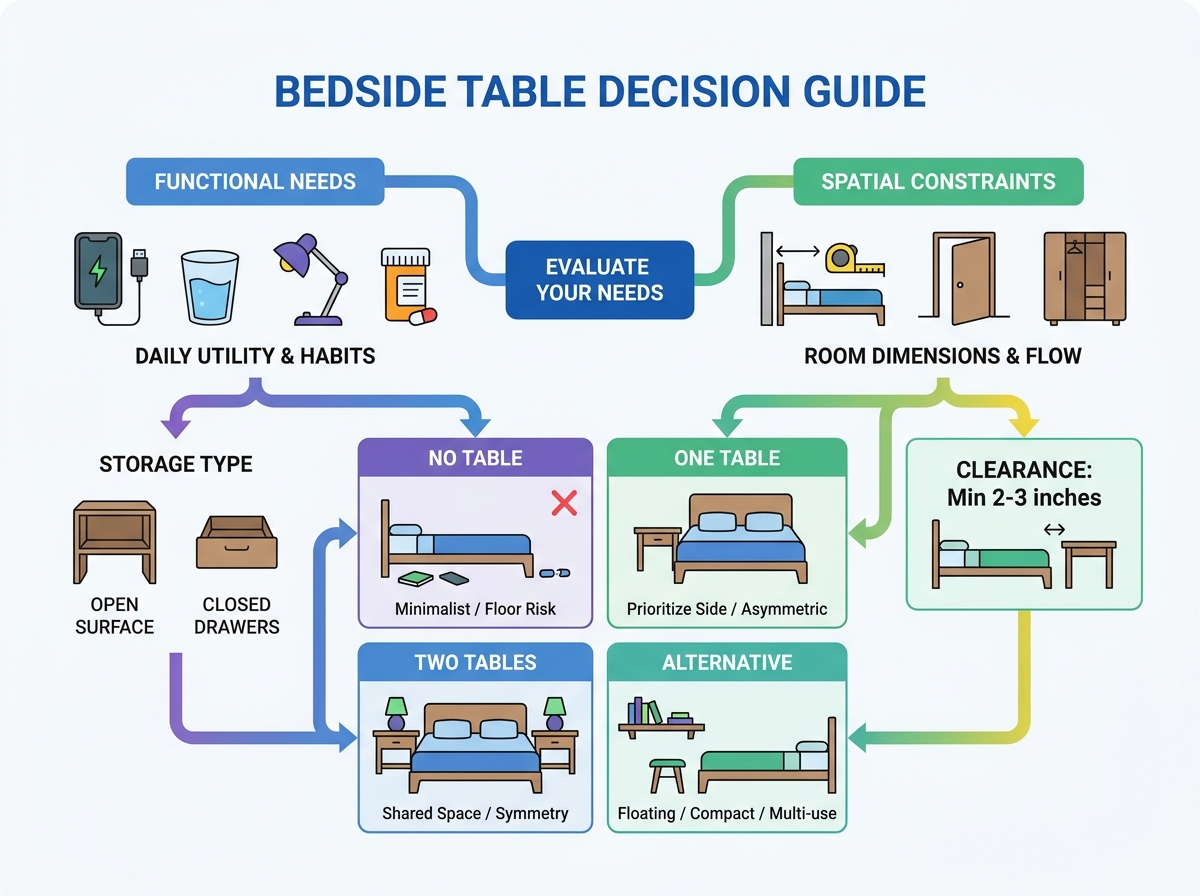
Spatial planning relies on strict industry-standard formulas. You must maintain a minimum of 2 to 3 inches of clearance between the bed frame and the table edge. This gap allows you to make the bed comfortably without scraping your knuckles. Furthermore, the table height should sit level with or slightly below the top of your mattress. Aligning the height prevents you from bumping your head. It also makes reaching for items ergonomically comfortable while lying down. Never eyeball these measurements; always use a tape measure.
Tight urban apartments require creative spatial solutions. You cannot always fit standard 24-inch wide nightstands. Here, a compact bedside table becomes incredibly valuable. Narrow profiles measuring under 15 inches wide solve the utility problem without penalizing your floor space. Nested designs or C-tables offer functional benefits while maintaining a tiny footprint. These smaller pieces hold your immediate essentials perfectly. They prove you do not need massive furniture to achieve excellent room functionality.
Selecting the right features depends entirely on your daily outcomes. Use the chart below to match your specific functional needs to the correct design solutions.
Design Solution Mapping Guide
Primary Need | Recommended Solution | Why It Works |
|---|---|---|
Device Charging | Tables featuring built-in cable management or open backs. | Prevents cord tangles and keeps power strips hidden from view. |
Clutter Control | Units equipped with a minimum of one enclosed drawer. | Hides medical devices, earplugs, and miscellaneous daily items easily. |
Visual Space | Glass tops or long-legged mid-century modern designs. | Allows light to flow through the piece, expanding the room visually. |
Establishing a baseline configuration starts with occupant count. Couples generally require two independent surfaces. Sharing a single surface creates frustrating logistical bottlenecks. One partner always has to reach across the bed or climb over the other to turn off a lamp. Providing two surfaces respects individual bedtime routines. It gives each person autonomy over their own devices, water glasses, and reading materials. For single occupants, a single unit usually suffices unless you prefer visual balance.
Many buyers falsely assume they must buy two perfectly matching tables. We challenge this symmetry myth. Asymmetric reality often works better for dynamic spaces. Mixing an open table on one side with a low dresser on the other can balance a room functionally. This approach maximizes your storage options. You might place a minimalist metal stand on the left and a heavy wooden chest on the right. As long as the heights remain relatively similar, the room will still feel visually balanced.
Hospitality spaces follow different rules. If you host an Airbnb or frequently have guests, providing at least one surface per sleeping side remains an industry standard. Guests need practical placement for travel items, phone chargers, and jewelry. Ignoring this standard reduces guest comfort significantly. Hospitality design emphasizes convenience. Ensure your guest spaces accommodate two adults easily by flanking the bed with accessible surfaces.
Sometimes, a room simply only accommodates one table comfortably. In these scenarios, you must practice spatial triage. Always prioritize placing the single surface on the side furthest from the door or closet. This placement maintains clear traffic flow in high-use areas. Blocking a closet door with furniture creates daily frustration. By moving the furniture piece to the far corner, you preserve the room's navigational ease while still securing a functional drop zone.
Traditional floor-standing units fail when space gets exceptionally tight. Floating or wall-mounted drawers provide a brilliant workaround. They free up valuable floor space instantly. You need this floor space to access under-bed storage drawers or to avoid blocking baseboard heating vents. Wall-mounted units require proper installation into wall studs to support the weight of books and lamps. Once installed securely, they deliver all the utility of a standard bedside table without eating up your walking path.
Do not limit yourself to items specifically labeled for the bedroom. Multi-functional compromises often yield the best design results. You can easily use a small writing desk as a nighttime surface. A sturdy wooden stool works perfectly for holding a single lamp and a book. Low bookcases or narrow dressers can pull double duty. Repurposing existing furniture saves money and adds unique character to your space. The only strict requirement is ensuring the height matches your mattress.
Before you purchase anything, you need a systematic approach. Follow these actionable steps to finalize your decision:
Measure your mattress height from the floor to the top of the bedding. Measure the available wall width on both sides of the bed.
Audit the specific items that absolutely must live next to the bed every single night.
Filter your product inventory by your required width, target height, and the need for open versus closed storage.
Match the new materials to your existing room textures, such as wood tones or metal accents. Do not worry about exact manufacturer matches.
Following this logic guarantees a functional, aesthetically pleasing outcome. You eliminate the guesswork from the buying process entirely.
The decision ultimately boils down to your specific daily habits rather than rigid design rules. We have established that this furniture piece is not universally required for survival. However, your nightly routine likely demands a localized surface to prevent frustration. Whether you choose zero, one, or two units depends entirely on your spatial constraints and storage needs. Evaluate your room objectively.
Do not delay your planning phase. Take immediate action today. Grab a tape measure and document your mattress height and side clearances. Doing this before browsing product catalogs saves you time. It helps you avoid costly return shipping fees on oversized, ill-fitting furniture. Plan carefully, measure twice, and upgrade your sleep sanctuary.
A: Ideally, the surface should sit perfectly level with your mattress top, or up to two inches lower. Taller tables increase the risk of bumping your head while sleeping. They also make it dangerously easy to knock items over when reaching up from a lying position.
A: Yes, you absolutely can. The only strict requirements are that the height aligns properly with your mattress and the footprint fits the space. Ensure the legs do not block your walking paths, closet doors, or heating vents.
A: Traditional Feng Shui suggests that pairs promote relationship balance and harmony. However, functionally speaking, a single well-placed table is vastly better than cramping a room. Forcing two pieces into a tight space blocks natural energy and ruins daily traffic flow.
A: Compact models generally range from 11 to 16 inches wide. Manufacturers design them specifically for tight, restricted spaces between beds and adjacent walls. They offer essential utility without overwhelming small urban apartment bedrooms.


