
 Resources & Catalogs

When purchasing furniture for a sleeping space, understanding exactly what is included in a bedroom set is the first step toward a successful room design. The appeal of buying a bundled furniture package is undeniable. It offers guaranteed aesthetic coordination and simplified logistics. However, confusing retailer terminology, inconsistent piece-counting methods, and deceptive listings frequently undermine this process. Buyers often assume a complete room solution is arriving, only to find missing components.
The core problem lies in the risk of purchasing a set only to discover missing structural elements. You might lack mattresses, support slats, or bed rails. Worse, you may realize the physical configuration overcrowds the room's actual square footage. This renders drawers unusable and walkways impassable. Without a clear understanding of industry standards, you risk making an expensive logistical error.
This guide provides a technical breakdown of standard furniture configurations, brand-specific packaging quirks, material evaluation frameworks, and space-planning criteria. By understanding how pieces are counted and evaluating the physical footprint of different bundles, you can ensure a confident, right-sized purchase that perfectly fits your space and functional needs.
Piece Counts Are Not Standardized: A "piece" can refer to a major structural item (like a bed frame) or a minor accessory (like a detachable mirror glass). Always verify the exact itemized packing list.
Mattresses Are Excluded by Default: Traditional furniture sets exclude the mattress and box spring. However, modern DTC "sleep bundles" are changing this norm by combining platforms with mattress packages.
Scale and Clearance Dictate Configuration: A 3-piece set is optimal for rooms under 120 square feet, while 5-piece to 7-piece sets require primary bedrooms exceeding 200 square feet to preserve functional 36-inch walkways.
Material Determines Lifespan: The price delta between visually identical sets is driven by construction—solid wood, wood veneers, or engineered laminate/melamine.
Defining the baseline components of bedroom furniture establishes a shared technical vocabulary. Before evaluating specific retail bundles, you must understand the individual elements that make up these collections. This prevents surprises upon delivery and ensures you have the necessary storage and structural support.
The bed frame serves as the structural anchor of the room. A standard bed consists of a headboard, a footboard, side rails, and a support slat system. These elements work together to hold the mattress securely while defining the room's primary design aesthetic.
Retailers employ a specific counting quirk when listing beds. Standard retailers count the entire bed frame as one single piece. However, some discount listings count the headboard, footboard, and rails as three separate pieces to artificially inflate the advertised set count. Always read the itemized manifest. Furthermore, distinguish between platform beds, which require no box spring due to a dense slat network, and panel beds, which require a separate box spring or foundation for proper mattress height and support.
Storage components vary significantly in their physical footprint and functional capacity. Understanding the distinction between a dresser and a chest dictates proper space planning.
Dresser: These are wide, horizontal, waist-high storage units. They typically feature 6 to 9 drawers and provide a broad top surface for display or mounting a mirror.
Chest of Drawers: These are narrow, vertical, shoulder-high units. They are optimized for small-footprint storage, utilizing vertical space rather than consuming valuable floor area.
Armoires and Wardrobes: These tall, standing closets feature doors opening over drawers or hanging rods. They are frequently offered as alternative storage add-ons in premium sets for rooms lacking built-in closets.
Nightstands play a spatial role in framing the bed, providing localized storage and a surface for lighting. They anchor the sleeping area visually and functionally.
Entry-level sets often default to a single nightstand. This means buyers must purchase a second matching unit separately to achieve symmetry. Verify whether a bundle includes one or two nightstands, as this drastically alters the functional layout of a shared sleeping space.
Mirrors designed to mount directly to dressers are frequently counted as standalone pieces. This tactic inflates the advertised set number. For example, a listing might promote a "3-piece set" that actually consists of a bed, a dresser, and a mirror, leaving you without a nightstand.
Luxury configurations often incorporate secondary accent pieces. These can include bed benches placed at the footboard, media chests designed to hold televisions and electronics, or matching writing desks for integrated home office functionality.
Contemporary furniture increasingly features modern components built directly into the frames. You will often find integrated LED headboard lighting or under-bed illumination for nighttime visibility. Built-in USB charging ports and wireless charging pads embedded directly into nightstand tops eliminate cable clutter and streamline device management.
Standard furniture sets exclude mattresses and bedding. This separation exists due to highly individualized ergonomic preferences regarding sleep surfaces. You are purchasing the structural frame and storage, not the sleep surface itself.
The "Sleep Bundle" exception is emerging through direct-to-consumer brands. These companies offer comprehensive packages containing a platform frame, mattress, and pillow set in one shipment. However, traditional hardwood furniture manufacturers maintain the separation between frame and mattress.
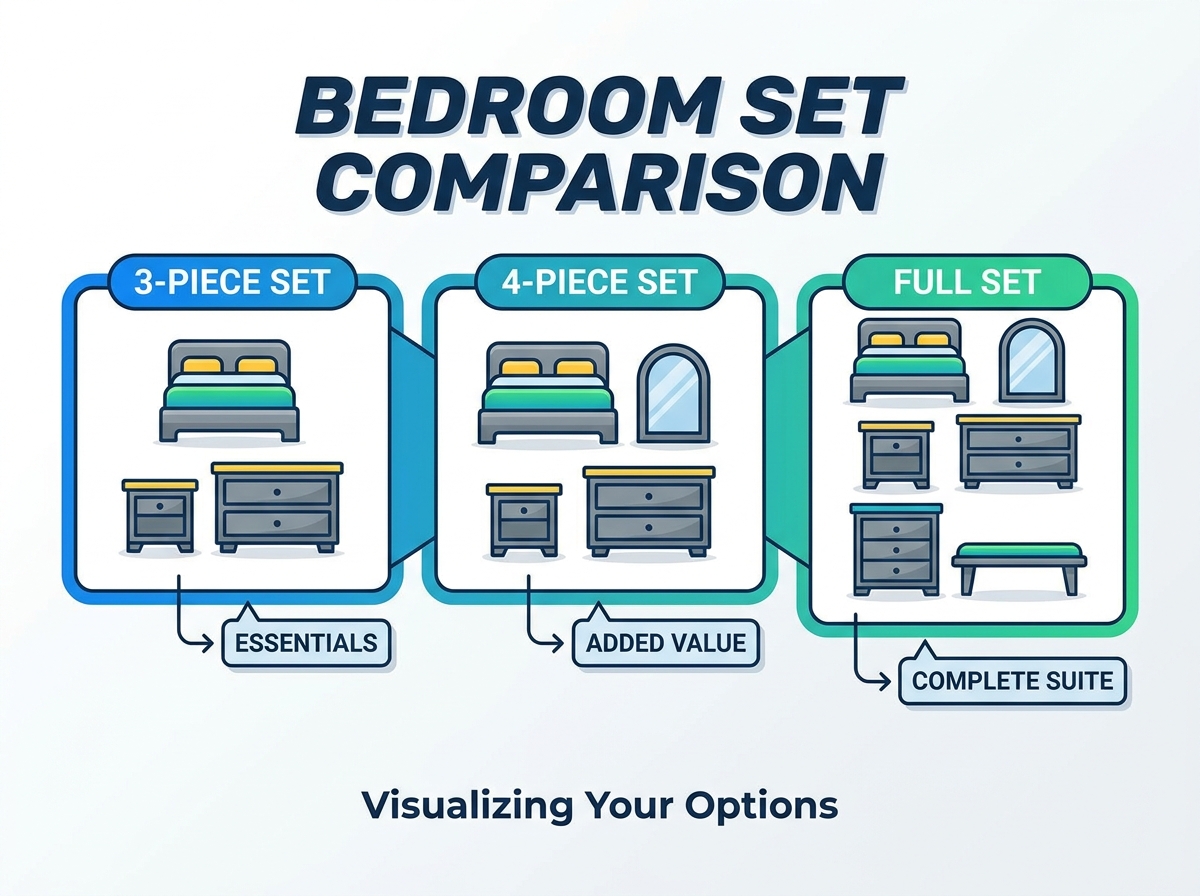
Breaking down the exact inclusions of standard industry bundles reveals brand-specific packaging formulas. Knowing what each tier typically includes helps you match the bundle to your room's square footage.
Configuration | Typical Inclusions | Ideal Room Size | Best Use Case |
|---|---|---|---|
3-Piece Set | Bed, Dresser, Mirror (or Nightstand) | Under 120 sq. ft. | Guest rooms, small apartments |
4-Piece Set | Bed, 2 Nightstands, Dresser | 120 - 150 sq. ft. | Standard secondary bedrooms |
5-Piece Set | Bed, 2 Nightstands, Dresser, Chest | 150 - 200 sq. ft. | Primary bedrooms for couples |
6/7-Piece Set | Bed, 2 Nightstands, Dresser, Mirror, Chest, Bench/Armoire | 200+ sq. ft. | Large primary suites |
The 3-piece bundle is the most common entry-level configuration. The standard retail formula typically includes the bed frame, a dresser, and a matching mirror. Alternatively, a space-saver formula might include the bed frame, one nightstand, and one dresser or chest.
This configuration is the ideal use case for guest rooms, apartments, rental properties, and bedrooms under 120 square feet. It provides essential sleeping and storage functions without overwhelming limited floor space.
A 4-piece configuration expands on the baseline to offer better symmetry. Typical inclusions consist of a bed frame, two nightstands, and one dresser. Alternative inclusions might swap the second nightstand for a mirror, resulting in a bed frame, one nightstand, one dresser, and one mirror.
This setup is the ideal use case for standard secondary bedrooms or guest rooms where balanced nightstand symmetry is desired. It provides functional convenience on both sides of the bed without requiring excessive storage capacity.
The 5-piece bundle serves as the standard for primary sleeping spaces. Typical inclusions feature a bed frame, two nightstands, one dresser, and one mirror or a tall chest of drawers.
This is the ideal use case for standard primary bedrooms where couples require dedicated individual storage. Having both a dresser and a chest, along with dual nightstands, ensures sufficient capacity for two wardrobes while maintaining a cohesive aesthetic.
These expansive bundles are designed to furnish massive spaces completely. Typical inclusions encompass a bed frame, two nightstands, a dresser, a mirror, a chest of drawers, and an auxiliary piece such as a bed-end bench, media console, or wardrobe.
The ideal use case for these sets is large primary suites exceeding 200 square feet. They require significant wall space and floor clearance. These bundles provide a fully coordinated design layout without the need to mix and match styles across a large room.
Beyond visual appeal, buyers must use technical criteria to assess a furniture bundle. Evaluating space, materials, and hardware ensures long-term functionality and durability.
Proper space planning relies on the "36-inch rule." This structural requirement dictates maintaining 36 inches of clearance around the bed and in front of dressers or chests. This clearance allows for full drawer extension, comfortable walking paths, and easy bed-making.
Map your room layout using painter's tape before purchasing. Outline the exact dimensions of the bed, nightstands, and dressers on your floor. This visualizes the actual physical footprint of a 5-piece versus a 3-piece bundle, instantly revealing if the larger set will choke the room's traffic flow.
The construction material directly impacts the lifespan and structural integrity of the furniture.
Solid Wood: Offers high structural integrity and is heavy. It remains susceptible to humidity expansion and contraction. It commands the highest price point but is fully repairable and refinishable over decades of use.
Wood Veneer: Consists of a thin slice of real hardwood bonded to an MDF or plywood core. It offers an excellent balance of cost-efficiency, warping resistance, and a natural aesthetic.
Laminate/Melamine: Features a synthetic printed surface over particleboard. It is highly budget-friendly and scratch-resistant, but impossible to refinish and prone to edge-peeling over time.
The internal construction details dictate how well the furniture performs daily. Look for English dovetails, which maximize drawer depth, or French dovetails, which are ideal for curved drawer fronts. These joints indicate superior craftsmanship compared to simple glued or stapled boxes.
Evaluate the drawer glides. Friction-fit wooden runners require wax and can stick. Side-mounted ball-bearing glides offer smooth operation, while premium undermount soft-close glides provide the best user experience and weight capacity. Additionally, ensure any set with built-in charging ports or LED lighting carries UL (Underwriters Laboratories) certification for electrical safety.
Analyze the trade-off between different storage styles. Deep-drawer traditional dressers offer high storage capacity but demand a massive floor footprint. Conversely, sleek mid-century modern designs or platform storage beds utilize under-bed drawers. This captures otherwise dead space, maximizing storage efficiency in smaller rooms without requiring additional freestanding chests.
Purchasing a bundle versus buying pieces a la carte involves distinct financial, design, and logistical trade-offs. Understanding these factors influences overall value.
Bundling offers clear financial advantages. Purchasing a 5-piece package is typically 15% to 25% cheaper than purchasing the exact same five items individually from the same retailer. Manufacturers and retailers incentivize bulk purchases through reduced margins, making complete bundles highly cost-efficient for outfitting an empty room.
The set advantage guarantees matching wood grains, finishes, and hardware profiles. It eliminates visual guesswork, ensuring a perfectly unified look immediately upon setup.
The curated alternative avoids the sterile, showroom look. By layering different textures, woods, and styles, you create a more custom, high-end interior design feel. However, this approach requires significant design confidence and time to source complementary pieces.
Purchasing a complete bundle often qualifies for flat-rate, white-glove delivery and assembly. The entire room arrives on a single truck, and professionals handle the heavy lifting and trash removal. Curating pieces from multiple vendors results in fragmented shipping fees, staggered arrival dates, and complex self-assembly demands across different instruction manuals.
Critical pitfalls often occur between purchase confirmation and final home placement. Anticipating delivery challenges prevents costly returns and property damage.
Measure entry doors, stairwells, tight hallway corners, and elevator dimensions, not just the bedroom walls. Large, fully assembled dressers or solid wood headboards cannot be easily disassembled if they fail to clear a tight staircase turn. Verify the boxed dimensions of the largest pieces against your home's narrowest choke points before finalizing the order. If you have concerns about delivery logistics, feel free to contact us for guidance on measuring your space accurately.
Measure the height and width of all exterior and interior doorways.
Check the clearance of any stairwell landings to ensure long items can turn the corner.
Verify elevator dimensions if you live in a multi-story building.
Clear the delivery path of rugs, artwork, and fragile items before the truck arrives.
By following these steps, you ensure the furniture you purchased actually makes it into the room without damaging your walls or the pieces themselves.
Review the itemized packing list before checkout to confirm exactly which pieces are included in the bundle.
Tape out the dimensions of the bed and dressers on your floor to verify you have 36 inches of walking clearance.
Inspect the drawer joinery and glide mechanisms to ensure the storage pieces will withstand daily use.
Measure all doorways, hallways, and stairwells to guarantee the largest assembled pieces can physically enter your home.
A: Standard furniture sets do not include a mattress or box spring. You are purchasing the wooden or upholstered frame and storage pieces. Mattresses must be purchased separately based on your specific comfort preferences.
A: A 3-piece set typically includes a bed, one dresser, and a mirror (or one nightstand). A 4-piece set usually adds a second nightstand, providing symmetry for shared beds, or includes a bed, two nightstands, and a dresser.
A: Yes, retailers frequently count the mirror that attaches to a dresser as a distinct piece. A listing for a bed, dresser, and mirror will often be advertised as a 3-piece bundle.
A: You should maintain a minimum clearance of 36 inches around the sides and foot of the bed. This space is necessary for comfortable walking, making the bed, and fully opening dresser drawers.
A: Not necessarily. While solid wood is highly durable and repairable, high-quality wood veneer over a stable core resists warping and splitting better in environments with significant humidity fluctuations.


