
 Resources & Catalogs

Designing a bedroom that supports both high-quality rest and aesthetic appeal requires more than just picking a bed. Buyers often overlook how flanking furniture dictates the room's overall spatial harmony. A haphazard choice easily disrupts your sleep environment. While traditional Feng Shui uses terms like energy flow or Chi, modern interior design translates these concepts directly. They map perfectly to environmental psychology, visual symmetry, and ergonomic safety. When you ignore these established guidelines, a space feels chaotic, unanchored, and subconsciously stressful. This article provides a practical, decision-focused framework for evaluating and selecting flanking pieces. You will learn how to balance rigid spatial design rules with functional nighttime storage needs. By applying these concepts, you transform an ordinary sleeping area into a highly intentional, restorative retreat. Proper layout planning ultimately saves you money and prevents buyer's remorse.
Symmetry is paramount: Using two bedside tables creates visual and psychological balance, though they do not strictly have to be identical if visual weight is matched.
Proportion matters most: The ideal bedside table sits flush with or slightly lower than the top of the mattress to prevent visual disruption and physical hazards.
Material dictates stability: Solid, grounding materials (like wood) are favored over fragile or reflective surfaces (like glass or mirrored finishes).
Concealed storage wins: Closed drawers support a functional bedroom furniture layout by hiding clutter, which reduces cognitive load and maintains spatial flow.
Achieving a stabilized focal point around your bed frame defines success in interior planning. The bed represents the heaviest visual object in the room. Feng Shui strongly advocates for flanking pairs to distribute this weight. This arrangement represents balance and partnership. We should frame this not as mysticism, but as proven spatial design. Humans naturally crave visual equilibrium in spaces dedicated to rest. When you flank a bed with matching units, you immediately anchor the room. It stops the eye from wandering unevenly across the space.
Consider the commercial application of this foundational rule. Luxury hospitality brands rely entirely on hotel bedside table coordination to establish premium comfort. They map their suites using perfectly symmetrical, matched nightstands and identical lamps. This immediate visual order signals calm and predictability to arriving guests. The human brain interprets this structured layout as a safe environment. You can easily replicate this calming, high-end effect in your own home.
Even solo sleepers benefit from this symmetrical approach. You might assume one unit suffices for a single occupant. However, a single unit forces the room into an unbalanced state. It creates a transient, unsettled atmosphere. Two units prevent this lopsided feeling completely. They provide equal visual weight on both sides of the mattress. Feng Shui also suggests this prepares the space for future partnership. Practically speaking, it ensures the environment feels complete, intentional, and architecturally sound.
Best practices for establishing structural symmetry:
Assess the available wall space on both sides before finalizing a bed size.
Ensure table lamps match in height to reinforce vertical balance.
Leave at least two inches of breathing room between the table and the bed frame.
Center the bed along the dominant wall to maximize proportional harmony.
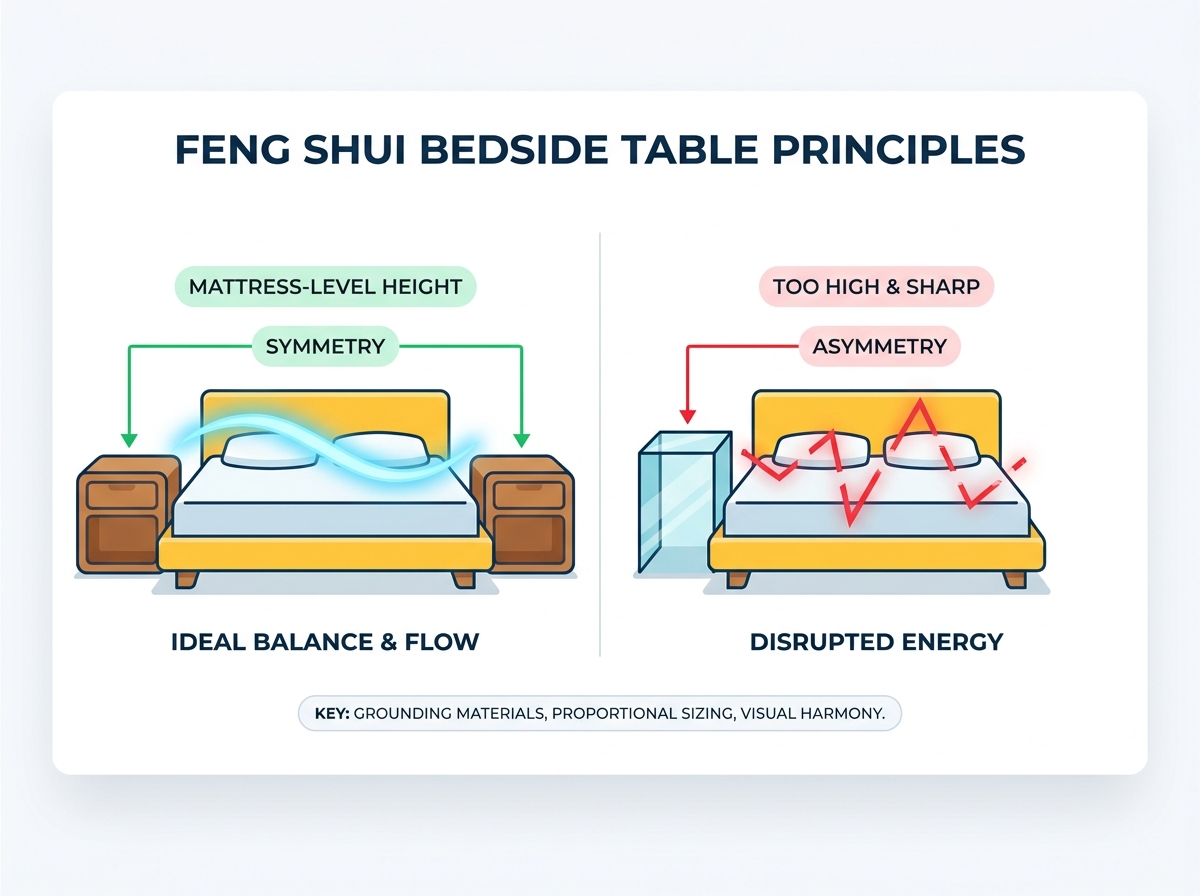
Evaluating construction materials directly impacts your daily comfort and sleep quality. We map specific features to concrete physiological outcomes. Solid wood grounds the space effectively. Wood absorbs ambient sound and offers psychological warmth. Glass or metal alternatives often feel cold, fragile, or institutional. They reflect light and create unnecessary visual tension. Traditional Feng Shui principles label these reflective surfaces as highly disruptive to restorative energy. They constantly bounce light and movement around the room.
Shape also dictates everyday ergonomic safety. Feng Shui advises strongly against poison arrows. These represent sharp corners pointing directly at the sleeper. In practical terms, this concept prevents physical harm during the night. Rounded edges or softened corners stop you from bruising your legs in the dark. They also visually soften the room. You want your sleep environment to feel welcoming, not hostile or dangerous.
When you filter product catalogs, you must prioritize solid construction. Look exclusively for matte or natural finishes. High-gloss, sharp-edged, or mirrored units require constant cleaning. They highlight dust and fingerprints immediately. Furthermore, mirrored finishes catch morning sunlight and street lamps. This unexpected glare might wake you prematurely, ruining your sleep cycle.
Common mistakes to watch out for during selection:
Choosing glass tops which amplify the noise of setting down a water glass.
Selecting flimsy metal frames which wobble loosely when you open a drawer.
Ignoring sharp corners in tight, high-traffic walkways around the bed.
Buying lightweight pieces easily knocked over during a restless night.
Proportion determines both daily functionality and overall spatial flow. The baseline rule remains incredibly simple. A bedside table should ideally sit level with the top of your mattress. This specific alignment creates a seamless visual line across the room. The eye travels smoothly without abrupt jumps. It also guarantees ergonomic comfort when you reach for an item from a lying position.
Implementation realities often complicate this straightforward baseline rule. Platform beds require entirely different dimensions than traditional box spring setups. Tables standing too high create a distinct claustrophobic feeling. They tower aggressively over your pillow. This positioning increases the risk of knocking heavy items onto your face. Conversely, tables sitting too low force awkward downward reaching. They disrupt your rest and strain your shoulder muscles.
Take pre-purchase action to avoid these costly proportional mistakes. Measure your exact floor-to-mattress-top height before browsing any catalogs. You must also factor in any future mattress toppers. A thick memory foam pad easily adds three to four inches to your bed profile. You must accommodate this extra height in your calculations.
Table 1: Ergonomic Impact of Bedside Table Heights
Height Relative to Mattress | Visual Effect on Room Flow | Ergonomic & Safety Outcome |
|---|---|---|
3 to 5 inches higher | Creates claustrophobia, disrupts sightlines | Awkward upward reach, high risk of knocking items onto the bed |
Flush or strictly level | Harmonious, continuous flow | Effortless access, supports safe movement in the dark |
1 to 2 inches lower | Subtle, unobtrusive presence | Comfortable reach, excellent safety margin for glass items |
3 to 5 inches lower | Visually disjointed, weak spatial anchoring | Strains shoulder, awkward downward reach causes muscle tension |
Many modern urban bedrooms lack the square footage for two standard-sized tables. We must address these spatial implementation risks practically. You do not need to abandon Feng Shui principles in a small apartment. You just need to adapt them cleverly. Rigid, catalog-perfect matching is not the only path to environmental harmony. Adapting to constraints requires a focus on proportion over exact duplication.
If limited space or budget dictates mismatched tables, use the visual weight workaround. Feng Shui allows for different designs provided they share similar overall dimensions. They must anchor the space equally. A delicate wire-frame table cannot balance a heavy oak cabinet. They possess different visual weights. You can unify different tables easily by matching the lamps on top. Identical lighting fixtures create an overarching bridge of symmetry above the mismatched furniture.
Small space solutions demand thoughtful creativity. You might face a closet door swinging open into the flanking zone. An ultra-narrow profile table works perfectly here. A floating wall shelf offers another excellent alternative. The focus must strictly remain on functional balance. You must provide utility for both sides of the bed.
Follow these progressive steps to balance mismatched furniture successfully:
Measure the width of both flanking walls to determine maximum allowable footprints for each side.
Select two pieces sharing at least one core design attribute, such as dominant color or material texture.
Ensure their top surfaces sit strictly within one inch of the exact same height.
Place matching lamps or identical framed artwork above them to trick the eye into seeing perfect symmetry.
Keep the clutter levels identical on both surfaces to maintain equal visual density.
Feng Shui explicitly warns against visual clutter in rest areas. It claims clutter blocks energy flow and causes mental unrest. Evidence-oriented psychology agrees completely with this ancient assessment. A messy line of sight actively increases human cortisol levels. It signals to your brain that work remains unfinished. Effective storage design eliminates this modern problem instantly. Keeping surfaces clear tells your nervous system it is time to shut down.
Evaluating storage types helps you optimize your bedroom furniture layout effectively. Open shelving presents a dangerously high risk for visual clutter. You should only choose open designs if you are naturally highly organized. They work well for displaying a carefully curated stack of books. Otherwise, they quickly become chaotic dumping grounds. Loose charging cables, receipts, and water bottles ruin the room's aesthetic completely.
Closed drawers represent the optimal choice for almost everyone. They allow you to hide charging cords, daily medications, and reading materials effortlessly. This conceals the chaos and maintains a clean, soothing top surface. A clear surface promotes a calm, distraction-free mind before sleep. The physical barrier of a drawer creates a psychological boundary against daily stress.
We highly recommend a specific next-step action today. Audit your current bedside items immediately. Count your books, chargers, lotions, and personal accessories. Determine if you truly need a single-drawer, three-drawer, or minimalist table. Do this physical audit before making any purchase. Understanding your exact volume needs prevents future overflow and wasted money.
Selecting the proper flanking furniture involves juggling multiple critical variables. It requires a precise balance of proportion, material safety, and symmetrical layout. We outlined a pragmatic framework connecting ancient spatial wisdom to modern environmental psychology. You can now approach your bedroom update with supreme clarity. You understand exactly why pairs matter and how height impacts ergonomics.
Applying these principles does not require adopting an Asian-inspired decor style. You can prefer mid-century modern, industrial, or rustic farmhouse designs. The underlying structural rules remain identical. You simply ensure the chosen furniture supports restful sleep and daily usability. Solid materials, matched heights, and concealed storage guarantee better sleep hygiene.
Measure your space carefully tonight. Audit your nighttime storage needs. Then, explore curated collections of solid, well-proportioned units. Focus on eliminating sharp edges and matching visual weights. Transforming your sleep environment begins with these simple, highly intentional design choices.
A: No. While exact matches offer easy symmetry, mismatched tables remain acceptable in Feng Shui. They simply need roughly the same height and visual weight. You can maintain spatial balance by using identical table lamps on top of different units.
A: Generally, yes. Having only one table creates an asymmetrical room. It can make a partner or future partner feel unaccommodated. If space is incredibly tight, install a floating shelf on the restricted side to restore visual balance.
A: Avoid fully mirrored tables or glass tops. They reflect ambient light and require constant cleaning. They also lack the solid, grounding psychological effect of wood. Reflective surfaces create visual tension that easily disrupts a calm atmosphere.
A: It is highly discouraged. Taller tables create cutting energy with sharp angles directed at your head. They are also functionally awkward to reach from a lying position. Always aim for mattress-level or slightly below.


