
 Resources & Catalogs
Buying a premium television is an exciting upgrade, whether you are outfitting a compact, contemporary apartment in Southeast Asia or furnishing a spacious, multi-generational family home in Africa and the Middle East. However, placing it on the wrong furniture can quickly turn movie night into a literal pain in the neck. Consumers across these diverse global markets frequently guess furniture dimensions based on room aesthetics rather than ergonomic principles. This oversight leads to poor viewing angles, safety risks like tipping, and costly buyer's remorse. When a screen sits too high or too low, your body naturally compensates, forcing your cervical spine out of alignment. Beyond physical discomfort, an improperly sized TV stand creates visual imbalance in your living space.
You need a reliable, math-based framework to calculate the exact furniture dimensions required for your specific seating height, room layout, and screen size. This guide breaks down the exact formulas and measurements needed to find the perfect fit, utilizing both imperial and metric systems to ensure accurate placement for homes anywhere in the world.
The optimal TV stand height places the center of the television screen directly at seated eye level, which typically averages 40 to 42 inches (101 to 107 cm) from the floor.
Use the industry-standard ergonomic formula: Seated Eye Level - (TV Height ÷ 2) = Ideal Stand Height.
As television screen sizes increase, the required furniture height decreases to maintain center-screen eye-level alignment.
To ensure structural stability and visual proportion, a TV stand should extend at least 2 to 3 inches (5 to 8 cm) beyond each side of the physical TV frame (equivalent to a 4 to 6-inch total width buffer).
A successful viewing setup requires neutral spine alignment, zero upward or downward neck tilt, and minimized screen glare. When you sit down to watch a movie, your gaze should naturally fall on the center of the screen without requiring you to lift or drop your chin. This neutral posture prevents muscle fatigue and allows for hours of comfortable viewing. The physical toll of incorrect placement is significant. Placing a television too high forces sustained cervical spine extension. This unnatural angle strains the neck muscles and fatigues the extraocular muscles as your eyes constantly look upward. Conversely, placing a screen too low causes you to hunch forward, compressing the spine and leading to upper back pain.
The industry baseline for seated eye level is generally 40 to 42 inches (101 to 107 cm) from the floor for standard living room seating. However, this measurement shifts depending on your furniture. Deep-slung lounge sofas or plush, traditional majlis-style seating popular in the Middle East drop your eye level significantly, while firm upright couches keep you elevated. Recliners tilt your head back, changing the angle of your gaze entirely, and bed frames require a much higher screen placement to accommodate a lying position. Understanding these variations is critical before selecting furniture for your home.
Consider the impact of ambient light and screen glare, a particularly vital factor in sun-drenched regions across Africa and Southeast Asia where vibrant natural light and large windows are common architectural features. A screen positioned above the optimal eye level often catches reflections from overhead lighting or bright outdoor rays. By keeping the screen centered at seated eye level, you minimize the angle of incidence for most standard room lighting, resulting in a clearer, more vibrant picture. Ergonomics extends beyond just the neck; it encompasses the entire visual experience.
Different seating arrangements demand specific height adjustments. A dedicated home theater with tiered seating requires careful calculation for each row to ensure unobstructed sightlines. A casual living room with a mix of bean bags, low sofas, and standard accent chairs requires a compromise, usually favoring the primary viewing position. Always prioritize the seat where you spend the most time watching.
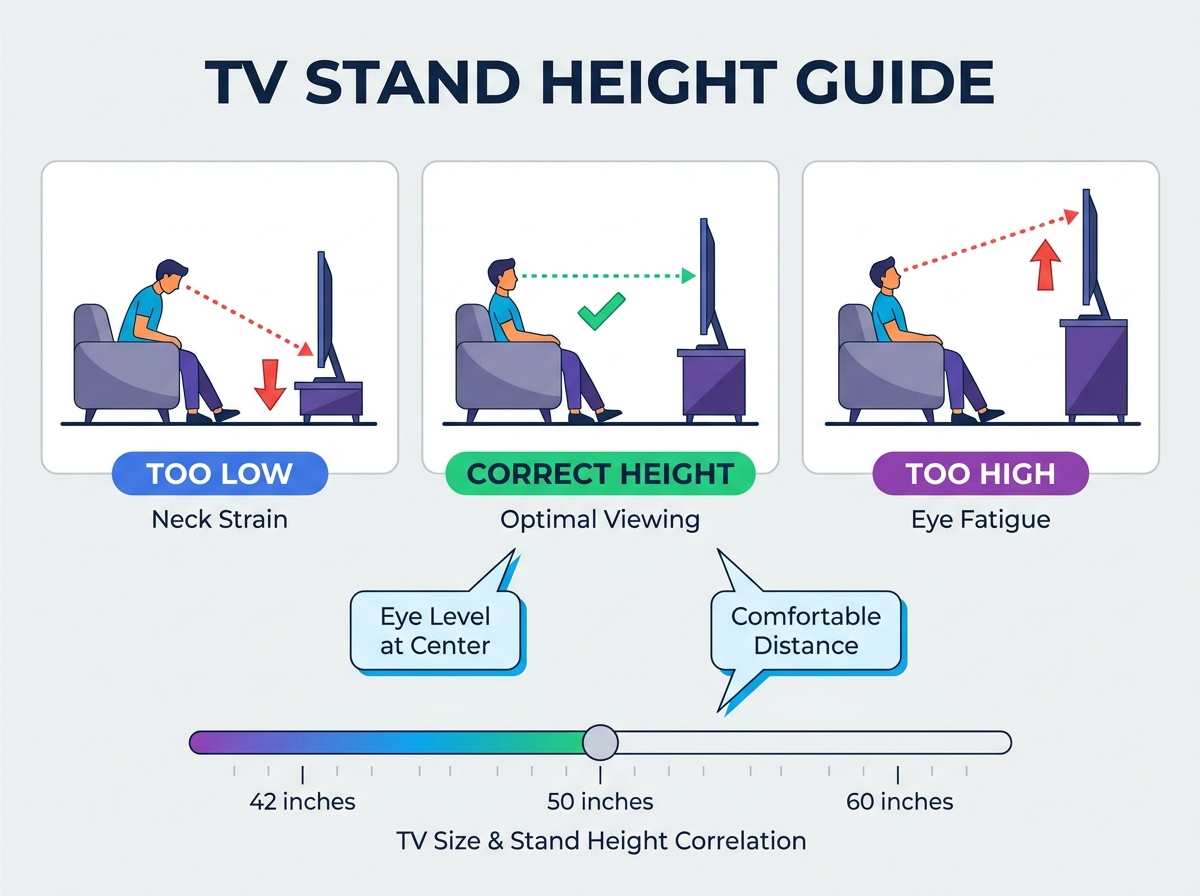
To make an accurate purchasing decision, you must abandon guesswork and rely on a simple mathematical framework. Finding the right height requires three specific measurements: your seated eye level, the physical height of the television, and the resulting target stand height. This evaluation dimension translates physical features into ergonomic outcomes.
Step 1: Measure Seated Eye Level. Sit on your primary sofa in your normal viewing posture. Allow the cushions to compress under your weight. Have a second person measure the distance from the floor directly to your eyes. This number is your baseline. Do not measure an empty couch, as cushion compression can alter the height by several inches depending on the foam density.
Step 2: Determine Actual TV Height. Clarify the critical difference between a TV's advertised diagonal class and its actual, physical vertical height. The diagonal measurement refers to the screen size from corner to corner. Check the manufacturer's specifications for the physical height in inches or centimeters without the factory legs attached. If you plan to use the factory legs rather than mounting the TV to a stand's integrated bracket, you must include the height of those legs in your calculation.
Step 3: Apply the Ergonomic Formula. The formula is straightforward: [Floor to Seated Eye Level] - [Half of the TV's Physical Height] = Target Stand Height. For example, a standard 65-inch television is approximately 32 inches tall. If your seated eye level is 40 inches, the math looks like this: 40" - (32" ÷ 2) = 24". Your target stand height is 24 inches. This ensures the exact center of the screen aligns with your eyes.
Let's look at another example using metric measurements, which are standard in Southeast Asia, Africa, and the Middle East. Suppose your seated eye level is 105 cm, and you have a 55-inch TV with a physical height of 70 cm. The calculation is 105 cm - (70 cm ÷ 2) = 70 cm. Therefore, you need a console that is approximately 70 cm tall. Applying this formula universally prevents the common mistake of buying furniture that looks good but functions poorly.
Baseline height recommendations rely on the standard 40-to-42-inch (101-107 cm) seated eye level. Exact requirements will vary slightly based on your specific television model's bezel thickness and the design of the stand itself. As a general rule, smaller screens require taller furniture, while massive screens demand a lower profile.
For 43-inch to 55-inch televisions, look for standard to slightly taller stands ranging from 24 to 32 inches (60 to 81 cm). Because these screens have less vertical real estate, they need more lift from the floor to reach eye level. Placing a 43-inch screen on a low-profile console will force you to look downward, causing neck strain over time.
For 65-inch televisions, the optimal sweet spot for modern mainstream living rooms falls between 24 and 26 inches (60 to 66 cm). This size is currently the most popular globally, and furniture manufacturers design the majority of their mid-height consoles to accommodate these dimensions perfectly.
Massive screens, ranging from 75 inches to 85 inches and beyond, require low-profile stands under 22 inches (55 cm). If you place an 85-inch screen on a standard 30-inch console, the top half of the screen will tower over the viewer, forcing an uncomfortable upward gaze. The sheer vertical height of these screens means the center point is much higher relative to the bottom edge.
TV Screen Size (Diagonal) | Approx. TV Physical Height | Ideal TV Stand Height (Standard 42" Seated Eye Level) |
|---|---|---|
43 inches | 22" (56 cm) | 30" to 32" (76–81 cm) |
55 inches | 27" (69 cm) | 26" to 28" (66–71 cm) |
65 inches | 32" (81 cm) | 24" to 26" (60–66 cm) |
75 inches | 37" (94 cm) | 20" to 22" (50–55 cm) |
85 inches | 42" (107 cm) | 16" to 18" (40–45 cm) |
Categorizing available furniture by height helps filter retail options efficiently. Low-profile stands, measuring under 20 inches (50 cm), are best suited for oversized screens (75 inches and up), minimalist interior aesthetics, and low-slung modular sofas. The trade-off is limited vertical storage space and the need for deep bending to access media components or route cables. These units often feature wide, horizontal lines that complement modern architecture styles frequently seen in upscale Middle Eastern and Southeast Asian urban developments.
Standard consoles range from 20 to 30 inches (50 to 76 cm). These are ideal for traditional living rooms, 55-inch to 65-inch screens, and standard 18-inch (45 cm) sofa seat heights. This category includes the highly recommended 50–60 cm consoles, which serve as excellent middle-ground solutions for multi-generational households in Africa and Southeast Asia, accommodating viewers of varying ages and heights. While this is the safest choice, it can raise larger screens past ergonomic thresholds if you aren't careful with your measurements.
Tall entertainment centers measuring 30 inches (76 cm) or more are designed for specific environments. They work well in bedrooms where viewing occurs from an elevated mattress, home bars, dining areas, or rooms with stadium seating. Using a tall console with a large screen in a standard living room setup creates a high risk of neck strain. These taller units often provide excellent storage capacity for books, media, and decorative items.
Integrated mount hybrid styles offer a distinct advantage for rental spaces where wall drilling is prohibited. These units provide height adjustability without causing wall damage. The television mounts directly to a spine attached to the back of the console. However, the mounting poles remain visible, and you must strictly adhere to the manufacturer's weight-bearing limits to ensure safety. This style allows you to achieve the floating look of a wall mount while retaining the storage benefits of a traditional console.
Physical dimensions dictate a secure, long-term setup. Height is only one part of the equation; width and depth are equally critical for stability. The furniture must extend at least 2 to 3 inches (5 to 8 cm) beyond the physical outer edges of the television frame on each side. This margin accommodates wide-set factory legs and prevents an unstable, top-heavy aesthetic. A screen that overhangs the edges of its base is a severe tipping hazard.
Weight capacity and tipping hazards present significant implementation risks. Always verify the manufacturer's weight limits, particularly if you utilize heavy legacy electronics, external audio amplifiers, or massive modern screens. The static load rating must exceed the combined weight of the television and all housed components. In large, bustling households with children or pets—common in the Middle East and Africa—anchoring the furniture directly to the wall is an absolute necessity to prevent catastrophic tipping accidents.
Factor in the physical footprint of your peripherals. Soundbars, center-channel speakers, gaming consoles, and rear cable management require adequate clearance. A minimum depth of 15 to 18 inches is typically necessary to house these components securely without pushing the television too close to the front edge. Receivers and amplifiers also require proper ventilation space above and behind the unit to prevent overheating, an especially crucial factor to consider in the warmer, tropical climates of Southeast Asia and Africa.
Cable management routing is another critical depth consideration. If the console sits flush against the wall, you need internal channels or a recessed back panel to route HDMI and power cables without pinching them. Measure the depth of your largest component, add two inches for cable clearance at the rear, and ensure the internal shelving can accommodate that total depth.
Buyers often face conflicting design and functional priorities. You may demand massive console storage, which naturally requires taller furniture, while owning a large television that requires a low-profile base. Balancing these needs requires strategic compromise. You cannot sacrifice ergonomic viewing height simply to gain an extra drawer for remote controls.
If you need extensive storage but want to maintain ergonomic viewing angles for a large screen, consider wall mounting the television above a lower console. This hybrid solution allows you to mount the screen directly to the wall at the perfect height while utilizing a slightly lower or floating unit underneath purely for housing peripherals, media storage, and grounding the room's visual design. This separates the structural support of the screen from the storage function of the furniture.
Another compromise involves utilizing flanking storage. Instead of a single tall console, use a low-profile base for the screen and place matching tall bookshelves or media towers on either side. This provides the necessary storage volume without elevating the screen above the optimal eye level. It creates a built-in look that maximizes utility while respecting biomechanical constraints.
Material selection also plays a role in the perceived bulk of the furniture. A solid oak console will look heavier and more dominant than a glass and metal unit of the exact same dimensions. Additionally, in regions prone to dust, such as parts of the Middle East and Africa, choosing designs with closed cabinets over open shelving can be a practical aesthetic choice that also protects your sensitive electronics.
Physical ergonomics and eye-level alignment must dictate the vertical placement of your screen, while room proportions and physical width dictate the footprint and styling of the furniture. Following a structured mathematical approach eliminates guesswork and ensures long-term comfort for viewers worldwide.
Measure your seated eye level from the floor while sitting on your primary sofa to establish your baseline.
Locate your television's exact physical vertical height and horizontal width on the manufacturer's specification sheet.
Apply the ergonomic formula to identify your target height and add 4 to 6 inches to the physical width to determine the minimum required furniture width.
Filter your retail options using these exact dimension brackets before considering aesthetics or storage features.
A: For a 65-inch television with a physical height of around 32 inches, a stand height of 24 to 26 inches is ideal. This keeps the center of the screen perfectly aligned with a standard 40-to-42-inch seated eye level.
A: Yes, the furniture should be at least 4 to 6 inches wider overall than the physical width of the television. This ensures a 2-to-3-inch overhang margin on each side, preventing accidental bumps and creating visual balance.
A: A 30-inch stand is well-suited for smaller screens under 50 inches or specialized viewing areas like bedrooms. However, it is generally too high for 65-inch or larger screens in a standard living room setup.
A: Sit on your primary sofa in your normal viewing posture. Allow the cushions to compress naturally. Have someone measure the distance from the floor directly to your eyes.
A: No. The diagonal measurement only indicates screen size. You must use the actual physical vertical height of the television, measured from top to bottom, to calculate the correct ergonomic placement.


